The Bridal Shop Owner’s Quality Checklist Before Choosing a Supplier
The Bridal Shop Owner’s Quality Checklist Before Choosing a Supplier
I’ve been in the bridal industry for 18 years, and if there is one thing I’ve learned from managing the floors here at Huasha Bridal in Suzhou, it’s this: A wedding dress is more than just a garment. It’s a promise. When a bride walks into your boutique, she isn’t just looking for a deal; she’s looking for the 'one.'
But for you, the boutique owner, that promise rests entirely on the shoulders of your manufacturer. I’ve seen shop owners lose sleep—and thousands of dollars—because a bulk order arrived looking nothing like the sample. In 2026, with the shift toward 'Transparent Luxury,' your customers are smarter than ever. They want to know where the lace comes from and why the bodice feels so secure.
So, how do you make sure your supplier is a partner and not a liability? I’ve put together this insider’s checklist to help you vet your next manufacturing partner with the eyes of a master designer.
1. The Soul of the Gown: Fabric and Trim Integrity
In my early days, I saw factories try to swap out high-GSM (grams per square meter) satin for cheaper, lighter versions that wrinkle if you just look at them. You can't afford that.
The Feel and the Fall
When you receive a sample, don't just look at it on a mannequin. Feel the weight. A premium crepe should have a 'cool' touch and a heavy drape that follows the body's movement. In 2026, we are seeing a massive demand for certified recycled lace and organic silks. Ask your supplier for the Fabric Technical Sheet. If they can’t tell you the exact fiber composition or the weight of the fabric, that’s a red flag.
The Lace Test
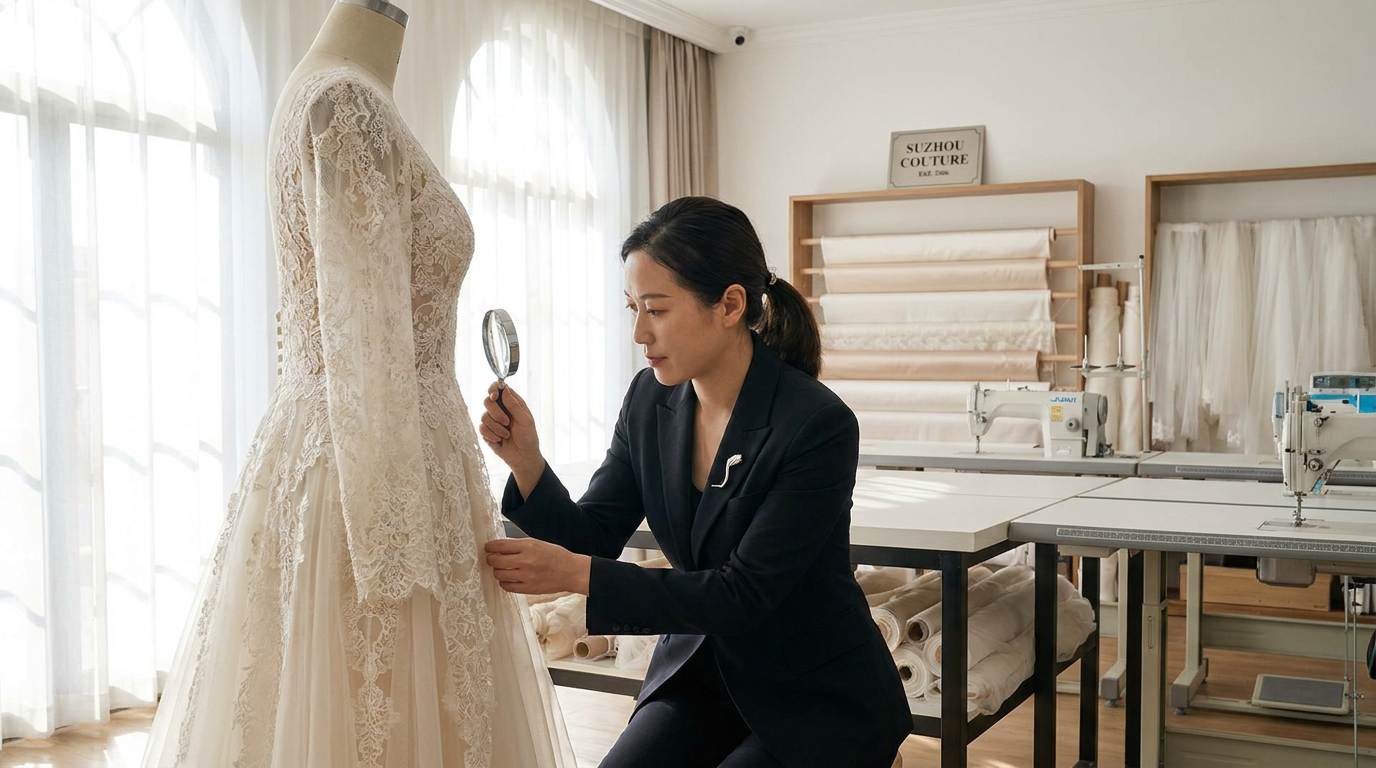
Lace is where most 'budget' factories cut corners. Look at the edges of the lace appliques. Are they 'fuzzy' or cleanly cut? High-end ODM manufacturing uses precise heat-cutting or manual trimming that ensures the lace looks like it’s growing out of the tulle, not just slapped on top.
2. The Skeleton: Internal Construction and Support
A dress can look beautiful on the outside and be a disaster on the inside. I always tell my partners: 'The beauty is in the bones.'
Boning and Structure
Flip the dress inside out. This is where the truth lives. How many bones are in the bodice? For a strapless gown, you want at least 8 to 12 high-quality resin or covered steel bones to ensure it doesn't collapse by the time the cake is cut. Cheap plastic boning will warp with body heat—I’ve seen it happen, and it’s not pretty.
The 'Ghost Seam' Technique
At Huasha, we pride ourselves on the 'Ghost Seam.' This is where the lining is perfectly tensioned against the outer shell so that the seams are invisible and the interior is as smooth as a second skin. If you see messy overlocking or loose threads inside the bodice, run. It means the factory is rushing their 'SMV' (Standard Minute Value) and skipping the quality checks.
3. The Craftsmanship Audit: Precision in the Details
As a designer, I’m obsessed with stitch density. It’s the smallest detail that makes the biggest difference in durability.
- Stitch Density: A high-quality gown should have 10-12 stitches per inch. Anything less, and the seams are prone to 'slippage' under stress.
- Beading and Sequins: Give the beaded area a gentle tug. Does the thread feel secure? We use a double-lock stitch for all hand-beading to ensure that if one thread catches, the whole design doesn't unravel.
- Zipper Integrity: A zipper failure on a wedding day is a boutique owner's worst nightmare. We only use YKK or equivalent high-grade bridal zippers, reinforced with an internal hook-and-eye closure.
4. The Human Element: Communication and Logistics
Quality isn't just about the dress; it's about the relationship. In 2026, you shouldn't have to guess what's happening in Suzhou.
Video-Verified Quality Control
If a factory won't hop on a WhatsApp video call to show you the production line in real-time, they are hiding something. I love taking our clients on virtual tours of our facility. It builds a level of trust that a PDF catalog simply can't match. You should see the QC stations where every dress is inspected against the AQL (Acceptable Quality Level) 2.5 standard.
Lead Time Transparency
We’ve all heard the '30-day' promise that turns into 60 days. A reliable partner provides a clear production schedule. At Huasha, we integrate our supply chain to ensure that the fabric is sourced and tested before the first cut is even made. This prevents those last-minute 'fabric out of stock' excuses.
Your 20-Point Quality Checklist Summary
Before you sign that contract or send that deposit, run through these quick hits:
- Fabric Weight: Does it match the GSM promised?
- Lace Edges: Cleanly trimmed or frayed?
- Boning Count: Sufficient for the silhouette?
- Stitch Density: 10-12 stitches per inch?
- Lining Quality: Is it breathable and well-fitted?
- Zipper Strength: Does it glide smoothly without catching tulle?
- Applique Placement: Is it symmetrical across the bodice?
- Hemline: Is the horsehair braid (if used) sewn evenly?
- Cup Shape: Are the bra cups natural-looking or 'pointy'?
- Inside Finish: No exposed raw edges or loose threads? ... (and 10 more technical points we provide to our strategic partners).
Conclusion: Why Experience Matters
Choosing a manufacturer is like choosing a business partner. You want someone who understands the stakes. For 18 years, Huasha Bridal has been the silent engine behind some of the most successful bridal brands in the US. We don't just ship dresses; we ship peace of mind.
If you’re tired of 'fast fashion' quality and want to elevate your boutique with gowns that actually sell themselves, let’s talk. I’d love to show you our latest collection via a live video tour.
Ready to see the Huasha difference? Contact us today to schedule your virtual factory visit.