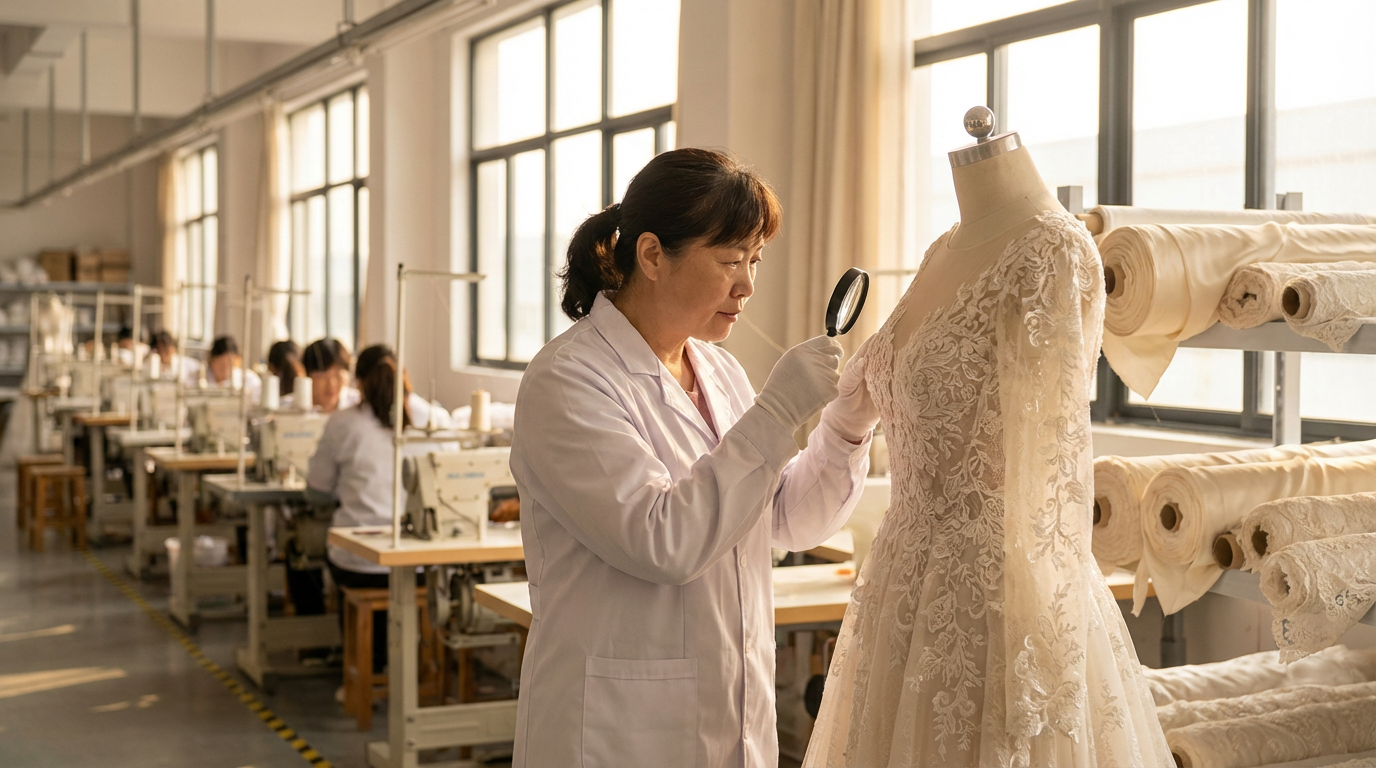
What Makes a Wedding Dress Manufacturer Chain-Store Ready? Capacity, QC & Delivery Reliability I remember a call I got three years ago from a boutique owner in Chicago who had just expanded to her fourth location. She was frantic. Her previous 'factory'—which turned out to be a small workshop—had completely ghosted her on a 200-gown reorder. The samples she had in her showroom were gorgeous, but the production batch was a disaster: uneven hemlines, mismatched lace motifs, and sizing that felt like it was from a different planet. This is what I call the 'Sample Room Trap.' Being 'Chain-Store Ready' isn't about making one beautiful dress for a trade show. It's about the industrial discipline required to make five hundred of them, all identical, all on time, and all perfect. At Huasha Bridal, we’ve spent 18 years in Suzhou mastering this balance. If you're managing 3, 10, or 50 locations, you don't need a vendor; you need a strategic manufacturing partner. Let’s talk about what that actually looks like behind the scenes. ## 1. Capacity: It’s Not Just About the Number of Machines When I tour potential partners for our clients, the first thing they show me is a floor full of sewing machines. But here’s the secret: capacity isn't just about hardware. It's about 'Line Balancing' and 'Buffer Capacity.' A chain-store ready factory doesn't run at 100% utilization. Why? Because if a top-selling style suddenly explodes in your stores and you need an urgent reorder, a factory running at 100% has nowhere to put you. At Huasha, we maintain a 15-20% capacity buffer. This allows us to pivot quickly when our partners need to capitalize on a trend. Furthermore, true capacity includes Institutional Knowledge. It’s the ability to translate a complex design into a 'Tech Pack' that a production line of 100 people can execute without 'sample-to-bulk' drift. If your manufacturer doesn't have a dedicated technical department for grading and construction specs, you aren't looking at a factory; you're looking at a large tailor shop. ## 2. The Anatomy of QC: Beyond the Final Glance Most people think Quality Control is someone looking at the dress before it goes into the box. In a high-volume environment, that’s way too late. If you find a mistake at the end, you’ve already lost time and money. We implement a 3-Stage QC Protocol that I believe should be the industry standard: * Stage 1: Raw Material & Trim Inspection: We test every roll of crepe, tulle, and lace for color consistency and 'seam slippage.' If the fabric doesn't hold the stitch under tension, it never touches the cutting table. * Stage 2: Mid-Production 'In-Line' Checks: Our QC managers walk the lines daily. They check the internal structure—the boning, the bra cups, the waist tapes. This is the 'skeleton' of the dress. If the skeleton is crooked, the lace will never sit right. * Stage 3: Final AQL 2.5/4.0 Inspection: We use international Acceptable Quality Levels. This means we don't just 'look' at the dress; we measure it against the spec sheet (US Sizing 0-28), check the bead security, and ensure the zipper glide is smooth. For a chain store, sizing consistency is the holy grail. If your 'Size 10' fits differently in January than it does in June, your stylists will lose confidence, and your returns will skyrocket. ## 3. Delivery Reliability: The 'On-Time In-Full' (OTIF) Mindset In the US market, a wedding date is a hard deadline. There are no 'do-overs.' As a manufacturer, our metrics for delivery aren't just 'did it ship?' but 'Was it On-Time and In-Full?' Navigating global logistics, especially with current tariff pressures and shipping delays, requires a proactive approach. We don't just book a container and hope for the best. We leverage Suzhou’s unique supply chain ecosystem. Because we are located in the heart of the world's bridal capital, our lace suppliers, beadwork artisans, and logistics partners are all within a 20-mile radius. This 'cluster effect' reduces our lead times and allows us to mitigate risks that would paralyze factories in more isolated regions. ## 4. Why This Matters for Your Bottom Line When you source from a factory that isn't chain-store ready, you are taking on 'hidden costs.' These include the cost of alterations for poorly sized gowns, the loss of sales due to late deliveries, and the mental tax of constantly 'firefighting' with your supplier. At Huasha Bridal, we focus on White-Label and ODM solutions that allow you to focus on your customers while we handle the heavy lifting of production. We provide transparent communication—often via WhatsApp video calls right from the factory floor—so you can see your production in real-time. ## Conclusion: Moving Toward a Strategic Partnership If you are tired of the 'sample room' games and need a partner who understands the stakes of multi-store retail, let’s talk. Our 18 years of experience aren't just about making dresses; they are about building the systems that allow your brand to scale without fear. Ready to see how a professional Suzhou factory operates? Reach out to us for a virtual showroom tour or a consultation on your next private label collection. Let’s turn your complex production needs into a clear, reliable solution.