How to Compare Bridal Suppliers Beyond Price Sheets and Product Photos
Let’s be real for a second. We’ve all seen those 'expectation vs. reality' memes. In the bridal industry, that meme isn’t just funny—it’s expensive. When you’re running a boutique, a bad batch of gowns isn’t just a headache; it’s a threat to your reputation and your bottom line. I’ve spent nearly two decades here at Huasha Bridal in Suzhou, managing production lines and talking to designers from New York to London. I can tell you right now: the price sheet is the least interesting thing a supplier can show you.
When you're scrolling through a catalog, every dress looks like a dream. But as a professional, you know that the magic—or the disaster—is in the details that a camera can't capture. If you want to build a sustainable bridal brand, you need to look deeper. Here is my guide on how to vet a manufacturing partner like a true industry insider.
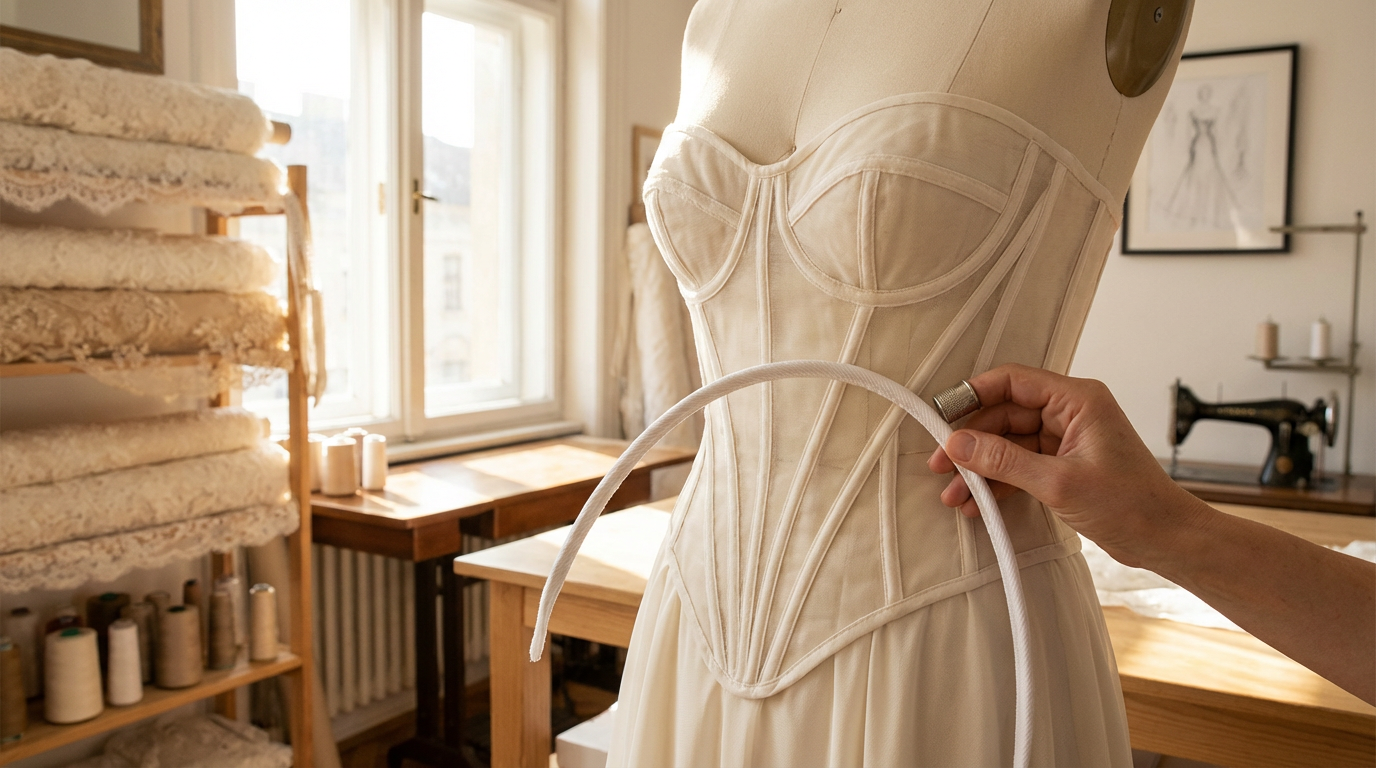
The Hidden Architecture: Boning and Structure
I always tell my partners: the beauty of a gown is on the outside, but its value is on the inside. Most 'budget' suppliers save money by cutting corners on the internal structure.
A standard wholesale gown might have four or six pieces of cheap plastic boning. On a hanger, it looks fine. On a bride? It collapses. At Huasha, for our high-end ODM collections, we use 12 to 22 pieces of high-density resin boning, strategically placed to create that 'corset' effect without the weight.
Pro Tip: Ask your supplier for a photo of the gown's interior, turned inside out. Look at the finishing of the bone casings. Are they raw or covered with soft ribbon? Is there an elasticated waist stay to take the weight off the shoulders? These are the marks of a factory that understands bridal engineering, not just sewing.
Fabric Forensics: Weight and Drape
Photos are masters of deception when it comes to fabric. A 'satin' dress on a website could be a heavy, luxurious 395-gram Duchess satin, or it could be a thin, shiny polyester that wrinkles if you look at it wrong.
You need to ask for the GSM (Grams per Square Meter). If a supplier can't give you the technical specs of their crepe, mikado, or tulle, they aren't the manufacturer—they're a middleman. For instance, a quality crepe should have enough weight to skim the body without showing every line underneath. If the fabric is too light, the gown will look 'cheap' the moment it's under boutique lighting.
The 'Vibe Check': Communication and Transparency
I’ve found that the best partnerships aren't built on the lowest price, but on the fastest problem-solving. When a shipment is delayed or a fabric goes out of stock, does your supplier hide, or do they call you with a solution?
In my 18 years at Huasha Bridal, I’ve realized that our most successful partners are the ones who treat us as their 'China office' rather than just a vendor. We use WhatsApp video calls to show our clients the cutting floor, the hand-beading stations, and the final QC check. If a supplier is hesitant to show you their actual facility via a live call, that’s a massive red flag. Transparency is the only currency that matters in international sourcing.
Navigating the 2025 Landscape
With the shifting sands of global trade and the 2025 US tariff discussions, you can't afford a supplier who is 'guessing' at logistics. A strategic partner should be able to discuss landed costs, duty-saving shipping methods, and production lead times that account for seasonal peaks.
We’ve seen a trend toward 'private label' as a way for boutiques to protect their margins. This means you need a factory that doesn't just copy designs but understands how to adapt them for your specific market. Can they change a neckline? Can they add a sleeve? If the answer is always 'no' or 'it’s too complicated,' they aren't a strategic partner; they're a commodity factory.
The 10-Question Litmus Test
Before you place that first bulk order, send these questions to your contact. Their answers (and how fast they give them) will tell you everything you need to know:
- What is the GSM of your primary crepe and satin fabrics?
- Can I see a photo of the internal construction (boning/cups) of your top-selling silhouette?
- Do you use AQL (Acceptable Quality Level) standards for your final inspection?
- Can we do a live WhatsApp video tour of your production line this week?
- What is your process for handling a manufacturing defect found after delivery?
- Are your laces sourced from local markets or do you have exclusive patterns?
- Can you provide a breakdown of lead times for samples vs. bulk re-orders?
- How do you manage quality consistency across different production batches?
- Do you offer white-label services (custom tags/packaging)?
- What are your strategies for mitigating the 2025 tariff impacts for US clients?
Conclusion: Your Success is Our Craft
At the end of the day, your brides don't care about your supply chain—they care about how they feel in the dress. But you have to care about the supply chain so they don't have to. Choosing a manufacturer like Huasha Bridal means choosing 18 years of Suzhou expertise, a transparent partnership, and a team that treats your brand's reputation as our own.
Ready to see what a real manufacturing partnership looks like? Let’s jump on a WhatsApp call. I’d love to show you around our Suzhou facility and discuss how we can bring your design vision to life without the usual sourcing headaches.