How Consistent Sizing Helps Bridal Shops Sell More Across Different Dress Styles
How Consistent Sizing Helps Bridal Shops Sell More Across Different Dress Styles
I remember sitting in a cozy boutique in Chicago a few years back. The owner, a sharp woman named Sarah, was nearly in tears. She had just received a shipment from a new supplier. She pulled out two dresses—both labeled as a US Size 10. One wouldn't even zip up on her smallest mannequin, while the other hung off it like a sack.
"How am I supposed to sell these?" she asked me. "Every time a bride tries on a sample that doesn't fit like the last one, I lose her trust. And my seamstress is booked out for six months just fixing manufacturer mistakes."
That conversation stuck with me. At Huasha Bridal, we’ve spent 18 years realizing that a wedding dress isn't just a piece of art; it’s a technical garment that needs to perform. In 2026, the bridal industry is finally waking up to 'Sizing Transparency.' If you want to scale your boutique, you have to stop fighting your inventory and start trusting it.
The Invisible Profit Killer: Sizing Inconsistency
When a manufacturer’s size chart is more of a 'suggestion' than a rule, your bottom line takes the hit. Think about the time your consultants spend 'pinning' a bride into a sample that is wildly off-spec. That’s time they aren't spending building a relationship or closing the next sale.
Inconsistent sizing leads to what I call "Size Shock." A bride who wears a street size 8 is already nervous about "bridal sizing" (which we all know runs notoriously small). If she tries on your "Size 12" and it fits like a 6, her confidence evaporates. When confidence goes, the credit card stays in the purse.
The Psychology of the 'Perfect Fit' Sample
We’ve seen it time and again: when a floor sample fits a bride remarkably well with minimal clipping, the closing rate jumps by nearly 30%. Why? Because she can finally see herself as a bride, not as a person struggling with a garment.
By partnering with a manufacturer that prioritizes consistent grading, you ensure that your Size 12 A-line feels exactly like your Size 12 Mermaid in the bodice. This predictability allows your stylists to pull gowns with confidence, knowing exactly how they will sit on the body.
How Huasha Bridal Solves the 'Fit Gap'
At our factory in Suzhou, we don't just scale patterns up by adding an inch here and there. That’s the old way, and it’s why so many plus-size gowns look like tents.
1. The Master Fit Block
We utilize a proprietary 'Master Fit' block for all our silhouettes. Whether we are designing a minimalist crepe sheath or an ornate royal ballgown, the internal structure—the boning, the cup placement, and the waist-to-hip ratio—starts from the same verified foundation.
2. The +/- 0.5cm Tolerance Rule
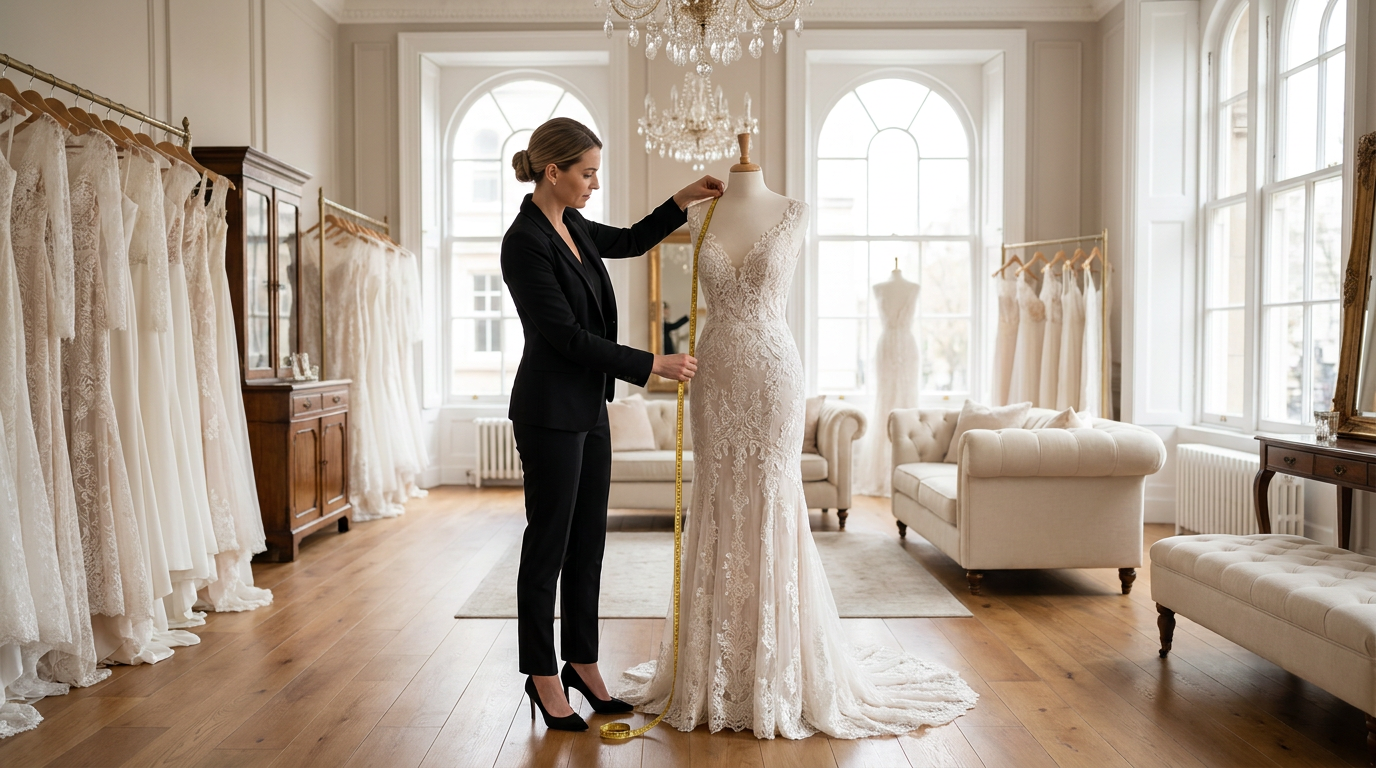
Our QC (Quality Control) team is legendary (and a bit feared) for their tape measures. Every dress that leaves Huasha Bridal must measure within a 0.5cm tolerance of the spec sheet. If a seam is off by a fraction, it’s sent back. We do this because we know that in bridal, a quarter-inch is the difference between a perfect fit and a 'pinch' that ruins the bride's day.
3. Fabric-Specific Grading
Not all fabrics are created equal. A heavy Mikado doesn't behave like a stretch georgette. I’ve seen factories use the same pattern for both, which is a recipe for disaster. We adjust our grading rules based on the fabric’s mechanical stretch and weight to ensure the finished garment actually fits the human body it was intended for.
Reducing the 'Alteration Bottleneck'
Let’s talk about your seamstress. In 2026, skilled labor is expensive and hard to find. If your manufacturer provides consistent, accurate sizing, the alterations become 'tweaks' rather than 'reconstructions.'
When you source from a reliable partner, you reduce the need for complex structural changes. This means:
- Faster turnaround times for your brides.
- Lower overhead costs for your alteration department.
- Higher customer satisfaction (no one likes paying $800 for alterations on a $2,000 dress).
Style vs. Fit: Maintaining the Standard
One of the biggest challenges for boutique owners is when a brand has a great 'Classic' collection but their 'Boho' line fits completely differently. We eliminate this frustration. By maintaining a unified engineering approach across all our ODM and white-label services, we ensure that your private label brand remains a beacon of reliability.
Your Strategy for 2026
If you’re tired of the "guessing game" every time a box arrives from China, it’s time to look at your manufacturing partner’s technical process.
At Huasha Bridal, we invite you to see our process firsthand. We can hop on a WhatsApp video call and I’ll show you exactly how we measure our gowns on the final QC line. We aren't just a factory; we are your strategic partner in making sure every bride who walks into your shop feels like the dress was made just for her.
Ready to stabilize your inventory and boost your ROI? Let’s talk about building a consistent size run for your boutique.