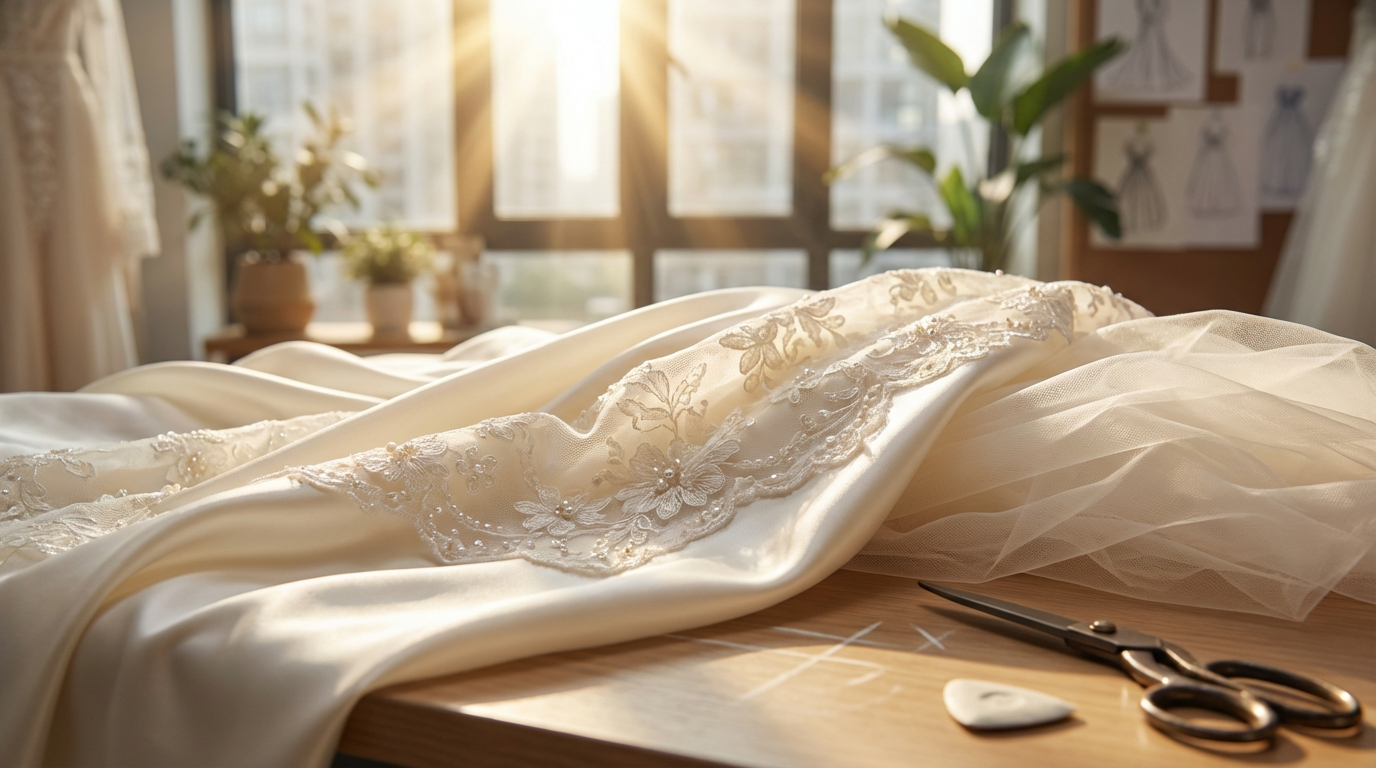
How to Source High-Quality Bridal Fabrics from China? A Factory Insider’s Guide
I’ll never forget a conversation I had with a boutique owner from Chicago named Elena. She’d spent three months designing a stunning minimalist collection, only to have the entire production run ruined because the 'heavy satin' she ordered from an online marketplace arrived looking more like cheap lining fabric. It was thin, it snagged if you even looked at it wrong, and it had a yellow tint that screamed 'budget' rather than 'bridal.'
That’s the fear, isn't it? The gap between a beautiful digital photo and the physical reality of a fabric roll.
At Huasha Bridal, we’ve spent 18 years bridging that gap. Based in Suzhou—the heart of the world’s bridal industry—we’ve seen it all. Sourcing high-quality fabrics from China isn’t about luck; it’s about having a system. Today, I’m pulling back the curtain to show you how we select the textiles that end up in the world's most prestigious bridal shops.
The Geography of Quality: Why Suzhou and Shaoxing Matter
In China, textile manufacturing is highly regionalized. If you are looking for premium bridal materials, you need to focus on two main hubs: Suzhou and Shaoxing.
Suzhou is the 'Silk Capital' and the global epicenter for bridal construction. This is where the craftsmanship lives. When we source lace or specialty satins, we are looking for mills that understand the structural needs of a wedding gown. Shaoxing, particularly the Keqiao district, is home to the world’s largest textile city. It’s where the innovation in synthetic fibers—like the high-luster 'Liquid Satin' trending for 2025—happens.
As a strategic manufacturing partner, Huasha Bridal acts as your eyes and ears in these hubs. We don't just buy what's available; we work with mills that meet our specific standards for weight, color, and durability.
The Essential Fabric Checklist: Evaluate Satin, Lace, and Tulle
When you are sourcing remotely, you can't feel the 'hand' of the fabric. However, you can ask for technical specifications that separate the professionals from the amateurs.
1. Satin: It’s All About the GSM
For a structured gown, you need a high GSM (Grams per Square Meter). A premium Mikado or Duchess satin should feel substantial. If a supplier can't tell you the GSM, walk away. At Huasha, we typically look for satins in the 280-320 GSM range for main body fabrics to ensure that 'expensive' drape and enough thickness to hide internal boning.
2. Lace: The Symmetry and Beading Test
Lace is the most common point of failure. High-quality lace should have clean embroidery edges without 'fuzziness.' If it’s beaded, the thread used for the beads must be high-strength nylon. I always tell my clients: 'Check the back of the lace.' The back tells the story of the quality—if it’s a mess of loose threads, the beads will fall off before the bride even reaches the altar.
3. Tulle: The 'Scratch' Factor
There is a massive difference between 'soft Italian-style tulle' and the stiff, scratchy stuff used in cheap costumes. We source tulle that has a high hole-density but remains soft to the touch. For 2025, we are seeing a huge move toward eco-certified recycled polyester tulle, which offers the same ethereal look with a better sustainability story for your brand.
Beyond the Swatch: 3 Technical Checks Every Buyer Must Know
A small swatch can lie. A 500-yard production run cannot. Here is how we verify quality at the factory level:
The Seam Slippage Test
Bridal gowns are often fitted tightly. We take a sample of the fabric, sew a standard seam, and apply tension. If the yarns start to pull apart at the seam (slippage), that fabric is a disaster waiting to happen during a bride's final fitting. We reject any fabric that doesn't pass this stress test.
The Delta E Color Check
Color consistency is the bane of bridal manufacturing. If your 'Ivory' from Batch A doesn't match Batch B, you can't offer consistent samples to your brides. We use spectrophotometers to measure the 'Delta E' (color difference). If the deviation is above a certain threshold, the batch is sent back to the dye house.
The 'Burn Test' for Fiber Content
Is it real silk or a high-grade polyester? While modern synthetics are incredible, you need to get what you paid for. A simple burn test—observing the smell and the ash—tells us the truth about the fiber content. We perform these audits on every incoming shipment at our Suzhou facility.
Navigating the 2025 Landscape: Tariffs and Transparency
With new tariff frameworks and a push for supply chain transparency, sourcing is getting more complex. US buyers are no longer just asking 'how much?' but 'where did this come from?'
This is where a partner like Huasha Bridal becomes invaluable. We provide the documentation you need—from OEKO-TEX certifications for skin-friendly textiles to transparent origin tracking. We manage the logistics and the risk, so you can focus on the design and the sale.
The Huasha Approach: Why We Are Your Quality Filter
At the end of the day, you aren't just buying fabric; you are buying peace of mind. When you partner with us for white-label or ODM manufacturing, we act as your quality filter. We have a dedicated QC team that inspects every meter of fabric before a single scissor-cut is made.
If there’s a snag in the tulle or a dye spot on the satin, we catch it at the source. We’ve spent 18 years building these relationships with mills so that you don't have to learn the hard way through a ruined collection.
Conclusion: Let’s Build Something Beautiful
Sourcing from China doesn't have to be a risk. With the right technical knowledge and a reliable partner on the ground, it’s your greatest competitive advantage. You get access to the world’s most innovative textiles at a price point that allows your boutique to thrive.
Ready to see the quality for yourself? Let’s hop on a WhatsApp video call. I’d love to walk you through our current fabric library and show you the textures we’re working with for the upcoming season. At Huasha Bridal, we don't just make dresses; we build the foundations of your brand’s success.
Contact us today to start your sourcing journey with a partner you can trust.