Top Bridal Gown Manufacturers in China with Proven QC Systems: A Real Talk Guide
I remember a conversation I had last year with a boutique owner from Chicago named Sarah. She was nearly in tears. She’d just received a shipment of fifty gowns from a new supplier in China. On the website, the lace looked like vintage Chantilly; in reality, it felt like stiff, scratchy plastic. The sizing was so off that her 'Size 10' wouldn't even zip up on a Size 4 mannequin.
"I feel like I'm playing a high-stakes game of roulette every time I place an order," she told me.
If you’ve been in the bridal industry for more than a minute, Sarah’s story probably sounds familiar. The truth is, China is home to some of the most skilled artisans and advanced bridal factories in the world—especially in the Suzhou cluster. But the gap between a 'good' factory and a 'nightmare' factory usually comes down to one thing: Quality Control (QC).
At Huasha Bridal, we’ve spent 18 years refining our systems so that our partners never have to experience a 'Sarah moment.' Let’s pull back the curtain on what a real, proven QC system looks like in a top-tier Chinese bridal factory.
The Suzhou Advantage: Why Location Matters
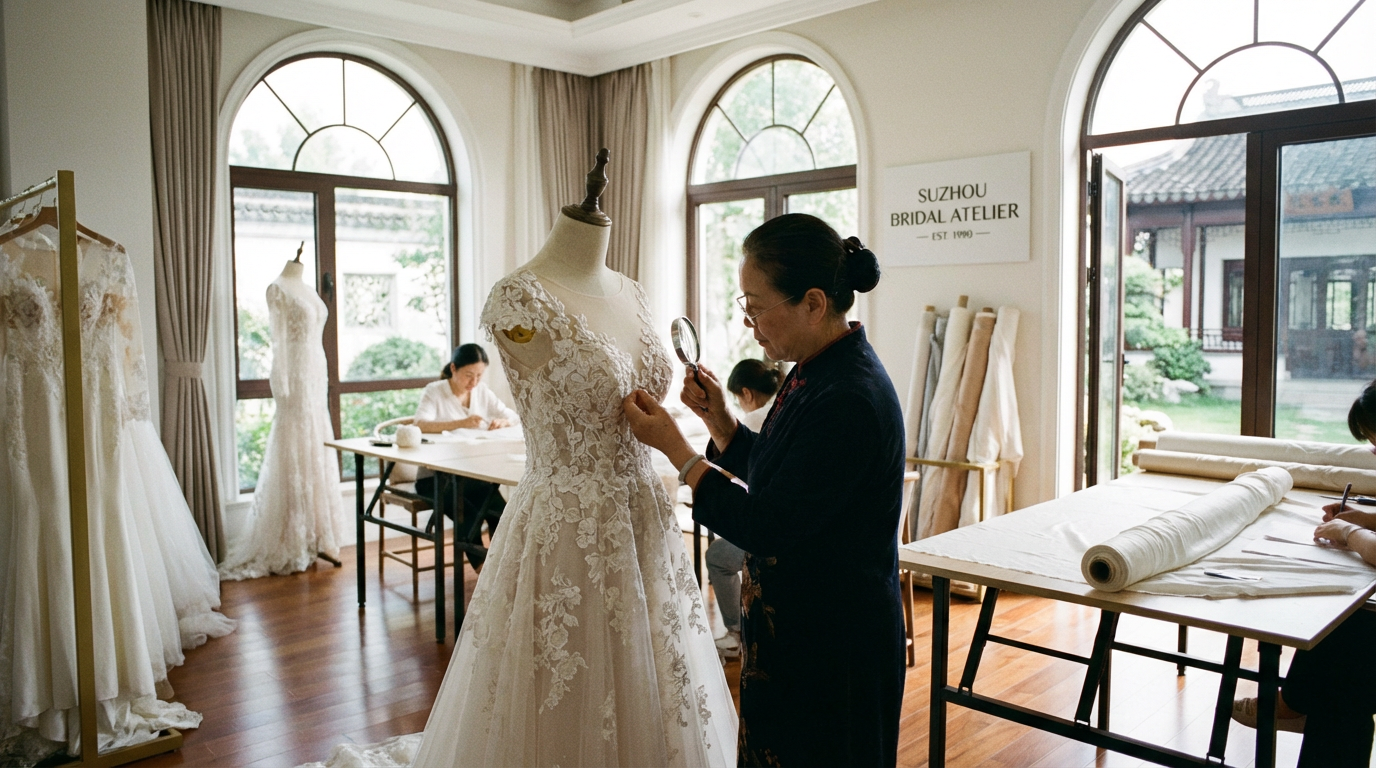
Suzhou isn't just a beautiful city of canals; it’s the heartbeat of the global bridal industry. When you work with a manufacturer here, you aren't just hiring a factory; you're tapping into a massive, specialized ecosystem. From the finest silk suppliers to master embroiderers who have passed down their craft for generations, everything is within a ten-mile radius.
However, being in Suzhou isn't enough. With so many players, the top manufacturers are the ones who treat QC as a science, not an afterthought.
The Three Pillars of a Bulletproof QC System
In my experience managing production lines, I’ve learned that you can't just 'inspect' quality into a dress at the very end. It has to be baked in at every stage. Here is the three-tier system we use at Huasha Bridal:
1. Pre-Production (PP) Samples: The Blueprint
Before a single yard of fabric is cut for your bulk order, we create a PP sample. This isn't just a 'pretty dress.' It’s a technical benchmark. We lock in the fabric specs, the lace placement, and the internal structure (the boning and cups). Once you approve this, it becomes the 'Golden Sample.' If the bulk doesn't match this, it doesn't leave the floor.
2. In-Line Inspections: Catching the Small Stuff
This is where most factories fail. They wait until the dress is finished to look at it. We don't. Our QC team performs 'In-line' checks. They look at the stitching of the bodice before the skirt is attached. They check the hand-beading halfway through. Why? Because it’s much easier to fix a tension issue in a seam when the dress is still in pieces than when it’s fully constructed.
3. Final AQL Inspection: The Gatekeeper
We use the Industry Standard AQL (Acceptable Quality Limit) for our final checks. This involves a rigorous 50-point checklist. We check for:
- Symmetry: Are the straps exactly the same length? Is the lace pattern mirrored correctly?
- Durability: Are the zippers reinforced? Is the beading secure?
- Cleanliness: No loose threads, no chalk marks, and absolutely no 'factory smell.'
The Sizing Nightmare: Engineering for the US Market
One of the biggest complaints I hear from US boutique owners is that Chinese 'standard' sizing is anything but standard. A 'Large' in China is often a 'Small' in New York.
Top manufacturers like Huasha Bridal solve this by using US-Standard Fit Models. We’ve engineered our patterns for sizes 0 to 28 specifically for the Western physique. We focus on the 'internal architecture'—the boning and power-mesh—to ensure that a size 20 provides the same support and silhouette as a size 4. This reduces your alteration costs and makes your brides much, much happier.
Avoiding the 'Quality Fade'
Have you ever had a first order look amazing, only for the second and third orders to slowly decline in quality? This is called 'Quality Fade.' It happens when factories try to pad their margins by substituting cheaper linings or less dense lace once they think they’ve 'won' your business.
At Huasha, we view ourselves as your Strategic Manufacturing Partner, not just a vendor. We maintain long-term contracts with our fabric mills to ensure that the satin you loved in 2024 is the exact same satin you receive in 2026. Transparency is our secret sauce.
How to Vet Your Manufacturer (Without Leaving Your Office)
I always tell my clients: don't just take my word for it. In today's world, you can vet a factory from your desk in California or London.
- Ask for a Video Walkthrough: I love hopping on a WhatsApp video call to show partners our showroom and, more importantly, our production floor. If a factory won't show you their sewing lines in real-time, ask yourself why.
- Request Tech Packs: A professional factory should be able to provide detailed technical specifications for their designs.
- Check the Export History: Look for manufacturers with at least a decade of experience dealing specifically with Western brands. They will understand your expectations regarding communication and quality.
Conclusion: Your Vision, Our Execution
At the end of the day, your brand’s reputation rests on the quality of the gowns on your racks. Choosing a manufacturer in China shouldn't be about finding the lowest price—it should be about finding the highest reliability.
If you're tired of the 'high-stakes roulette' and want a partner who treats your designs with the respect they deserve, let’s talk. At Huasha Bridal, we turn complex production needs into clear, reliable solutions.
Ready to see the difference 18 years of expertise makes? Contact us today for a virtual tour of our Suzhou facility or to discuss your next private label collection.