Tulle Trouble: 5 QC Red Flags You Can Spot in Under 60 Seconds
I’ve been in the bridal manufacturing game for over 18 years here in Suzhou, and if there’s one thing I’ve learned, it’s that tulle can be your best friend or your worst enemy. You know the feeling: a shipment arrives from your manufacturer, you pull out that stunning ballgown, and something just feels... off.
For a boutique owner or a DTC brand manager, your reputation is built on the tactile experience of the bride. When she steps into a dress, she isn't thinking about GSM (grams per square meter) or denier counts—she’s thinking about how that fabric feels against her skin. If it’s scratchy, stiff, or looks "cheap" in photos, the sale is dead before she even looks in the mirror.
At Huasha Bridal, we’ve perfected the art of the "60-Second Scan." Here are the five red flags I tell all my partners to look for the moment they open a box. Trust me, these will save you thousands in returns and alterations.
1. The "Scratch Test": Comfort is Your Biggest Sales Driver
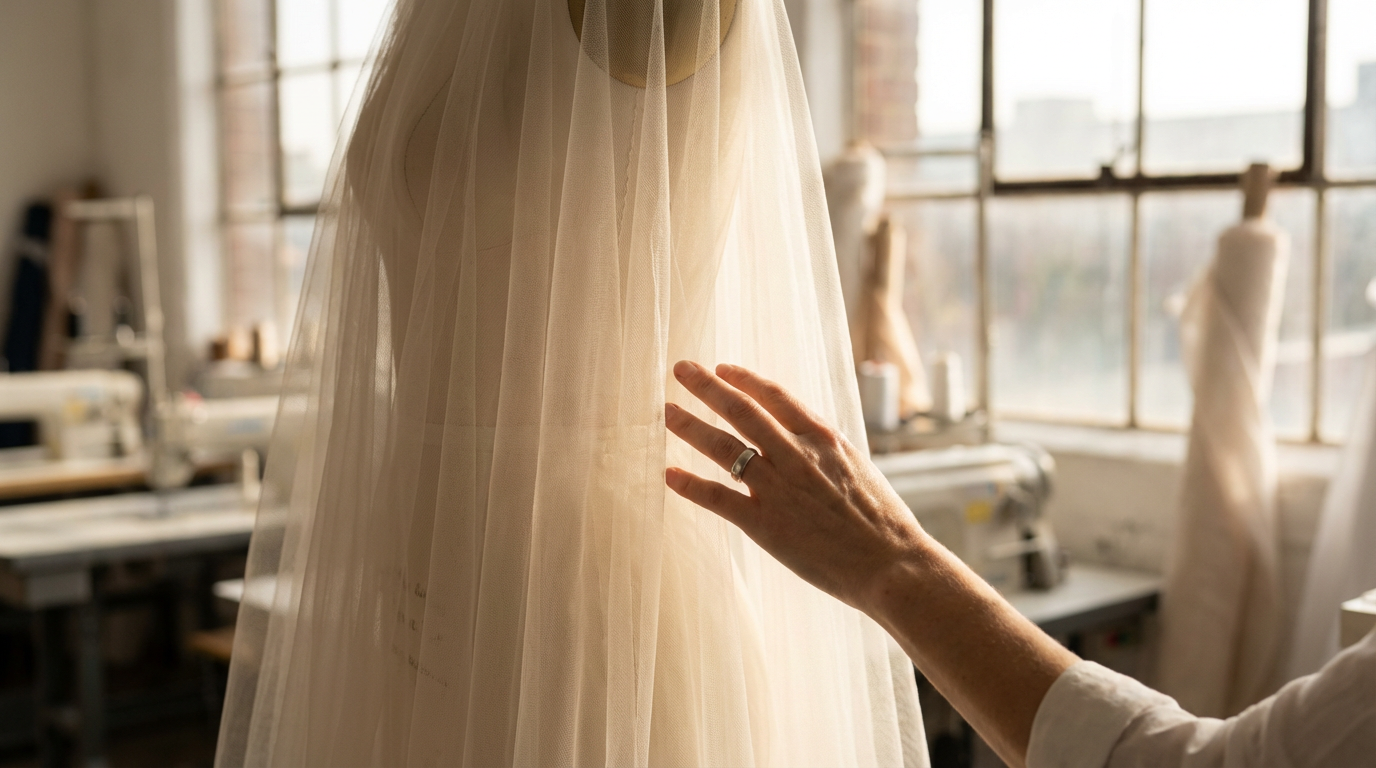
This is the easiest test in the book. Close your eyes and run the back of your hand—where the skin is most sensitive—along the layers of tulle.
The Red Flag: If it feels like a plastic scouring pad or leaves a faint red mark on your skin, it’s likely low-grade polyester tulle.
High-end bridal gowns should use Nylon 6 (Polyamide). It’s softer, cooler to the touch, and has a much better drape. Cheap tulle is often stiffened with chemical resins to give it volume, but those chemicals can cause skin irritation for the bride on her big day. At Huasha, we source our Nylon tulle specifically for its "skin-feel" because we know a comfortable bride is a happy bride.
2. Mesh Inconsistency & "Clouding"
Hold a single layer of the tulle up against a window or a bright light source.
The Red Flag: Look for "clouds"—areas where the hexagonal mesh looks denser or more opaque than others. Also, check for irregular hole sizes.
Inconsistent mesh is a sign of poorly maintained knitting machines. When these layers are stacked, those inconsistencies create shadows that look like stains or dirt in high-resolution wedding photography. If your tulle isn't uniform, your bride's photos won't be either. We use high-precision German-made knitting technology to ensure every square inch of our tulle is identical.
3. The Snag Factor: Durability vs. Delicacy
Take a small section of the tulle and gently rub it against a piece of beaded lace or even a ring with a prong setting.
The Red Flag: Does it catch and immediately create a "run" or a permanent pill?
While all tulle is delicate, high-quality bridal tulle has a specific "elastic recovery." If it snags at the slightest touch, your boutique floor samples will look ragged within a month. We test our tulle for "seam slip" and snag resistance because we want your inventory to stay pristine through dozens of try-ons.
4. Color Drift: The Ivory Trap
Lay the new shipment next to your original showroom sample.
The Red Flag: Does the new dress look slightly more yellow or "fluorescent" white than the sample?
This is called color drift. Many factories in China source tulle from different markets for every order to save costs. At Huasha, we maintain a strict fabric library. We use spectrophotometers to ensure that the "Light Ivory" you ordered in January is the exact same "Light Ivory" that arrives in June. There is nothing worse than explaining to a bride why her dress doesn't match the one she tried on.
5. Structural Integrity: The Waistline Stress Test
Check where the tulle meets the bodice or the zipper.
The Red Flag: Look for visible needle holes that seem to be stretching or "tearing" the tulle.
Because tulle is a mesh, it requires specialized needles and tension settings. If a factory uses standard needles, they chop through the fibers rather than sliding between them. Over time, the weight of the skirt will cause the tulle to pull away from the bodice. At our Suzhou facility, we use ball-point needles specifically designed for fine mesh to ensure the dress stays together through the ceremony and the dance floor.
The 60-Second QC Workflow
Next time a shipment arrives, do this:
- 5 Seconds: Feel the fabric (The Scratch Test).
- 10 Seconds: Hold it to the light (The Mesh Scan).
- 15 Seconds: Check the color against your master sample.
- 15 Seconds: Inspect the waistline and zipper seams for needle damage.
- 15 Seconds: Give the skirt a gentle shake to see how it settles (Drape check).
Partner with a Factory That Cares About the Details
Sourcing from China shouldn't feel like a gamble. At Huasha Bridal, we act as your strategic manufacturing partner. We don't just ship dresses; we ship peace of mind. Our 18 years of experience mean we’ve already solved the problems you’re worried about.
Ready to see the Huasha difference? Let’s hop on a WhatsApp video call. I’ll take you through our Suzhou showroom and show you exactly how our tulle passes the test.