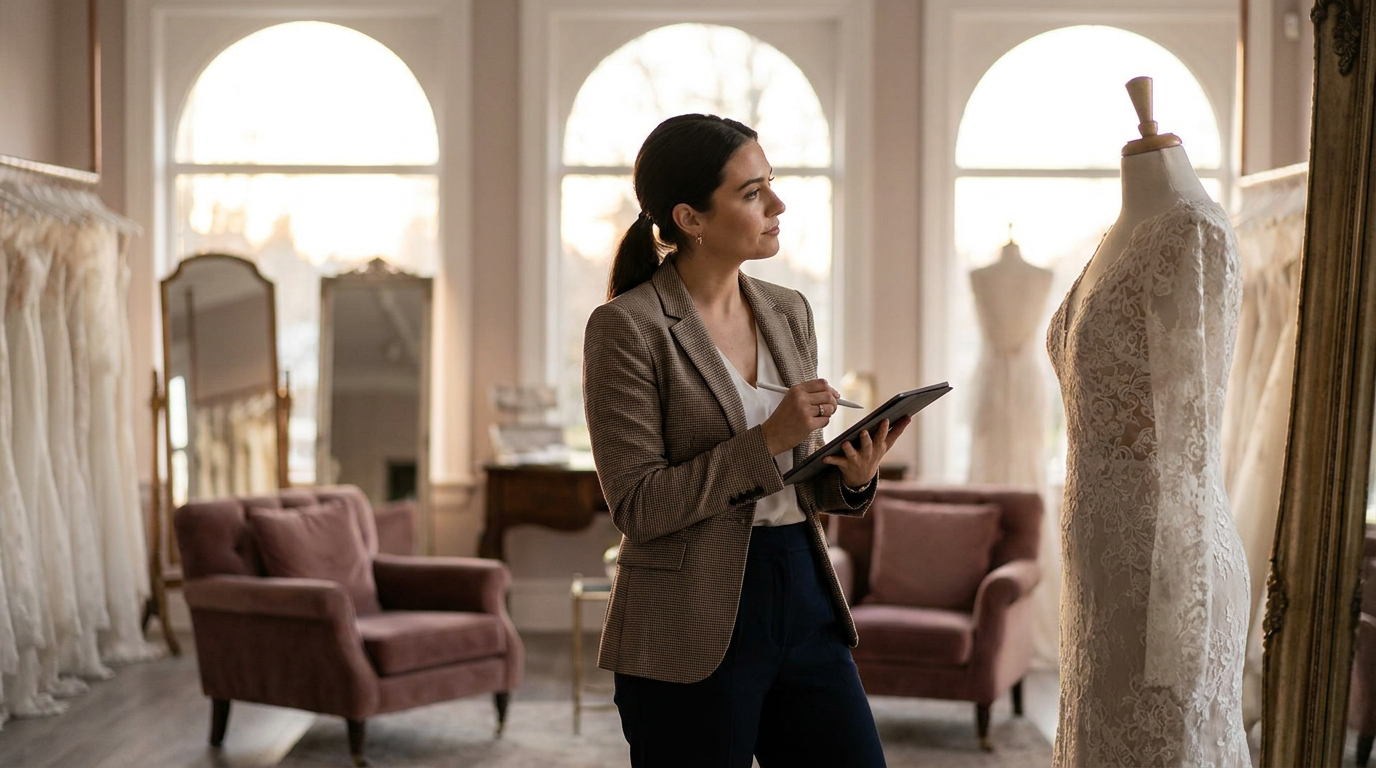
How Bridal Buyers Can Turn Store Feedback into Better Wedding Dress Designs
I’ve spent nearly two decades on the factory floor in Suzhou, and if there’s one thing I’ve learned, it’s this: The most valuable designer in the world isn’t sitting in a high-rise in Milan. She’s standing in your fitting room, looking at herself in the mirror, and saying, "I love this, but..."
That "but" is where the money is.
At Huasha Bridal, we’ve helped hundreds of boutique owners move past the traditional 'buy and hope' model. In 2026, the game has changed. We are in the era of Intentional Design. You shouldn't just be a buyer; you should be the bridge between the bride's reality and the factory's execution.
Here is how you can take those messy, emotional fitting room notes and turn them into a best-selling private label collection.
The 'Fitting Room Journal': Your Best R&D Lab
Most buyers rely on memory or a vague 'feeling' when they talk to me about their next order. "The girls liked the lace, but they wanted more support," they might say. That’s a start, but it’s not enough to build a brand on.
I always tell our partners to keep a Fitting Room Journal. Every time a bride tries on one of your white-label or ODM pieces, your stylists should log three things:
- The 'Yes' Trigger: What made her eyes light up? (The sparkle? The way the train moved?)
- The 'No' Factor: What made her hesitate? (Was the neckline too low? Did the boning poke her side?)
- The 'Wish List': What one thing would she change to make it perfect?
By the end of a quarter, you’ll have a data set. If 40% of your brides loved a specific A-line silhouette but complained that the lining felt 'sticky,' you don't just stop ordering that dress. You come to me and say, "Huasha, we love the silhouette of HB802, but we need to swap the polyester lining for a breathable stretch satin."
Categorizing Feedback: Comfort, Aesthetic, and Functionality
To talk to a manufacturer like a pro, you need to categorize what you’re hearing. When you send us feedback, try to break it down like this:
1. Comfort Feedback (The 'Feel')
If a bride says a dress is 'heavy' or 'itchy,' that’s a technical problem with material selection.
- The Fix: We might suggest reducing the layers of stiff crinoline and replacing them with a structured horsehair braid on the hem to maintain the volume without the weight.
2. Aesthetic Feedback (The 'Look')
This is usually about trends. Maybe the 'clean look' is in, but your current stock has too much 3D lace.
- The Fix: We can take your best-fitting bodice pattern and simply 'strip' the lace, replacing it with a high-quality Mikado or Crepe for a minimalist aesthetic. This is the heart of Micro-Customization.
3. Functionality Feedback (The 'Fit')
"I can't lift my arms." "The bust feels flat." This is about construction.
- The Fix: We can adjust the armscye (the armhole) or add internal 'power mesh' to the bodice for better snatching without needing extra alterations later.
Technical Translation: How to Speak 'Factory'
One of the biggest hurdles in bridal manufacturing is the language barrier—not just English to Chinese, but 'Retailer' to 'Engineer.'
When a bride says, "The top feels flimsy," I need you to translate that for me. Does she mean the cups are too thin? Does she mean the boning isn't stiff enough? Or is the lace too stretchy?
At Huasha Bridal, we pride ourselves on being your Strategic Manufacturing Partner. We don't just take orders; we consult. If you tell me your brides are asking for more 'modularity,' I know exactly what to do. We can design detachable sleeves or overskirts that use the same lace motifs as the gown, giving your brides two looks in one—a huge trend for 2026.
Case Study: The Sleeve Modification That Saved a Collection
Last year, a boutique owner in Texas came to us. She had a beautiful off-the-shoulder ODM design that was failing. Brides loved the look on the hanger, but in the fitting room, they felt restricted. They couldn't dance.
She shared this feedback with me during a WhatsApp video call. We looked at the sample together. I realized the lace we were using had 0% stretch, and the sleeve cap was too high.
The Solution: We re-engineered the sleeve with a hidden elastic gusset and switched the lining of the sleeve to a soft, multi-way stretch tulle.
The Result: That dress went from her lowest performer to her #1 best-seller in three months. That is the power of a feedback loop.
Why This Matters for Your Bottom Line
Every time you make a design better based on real feedback, you are doing two things:
- Increasing Conversion: More 'Yes' moments in the fitting room.
- Lowering Alteration Costs: If the dress fits better and feels better off the rack, your seamstress spends less time fixing factory 'flaws' and more time on custom tweaks.
Let’s Build Your 2026 Collection Together
You see the brides; I see the machines. When we put our heads together, we create magic.
If you’re tired of manufacturers who just say "yes" to everything without understanding the why behind your requests, let's talk. I invite you to book a video tour of our Suzhou facility. Show me your 'problem' dresses. Tell me what your brides are whispering in the fitting room.
Let’s turn those whispers into your next sold-out collection.
Ready to refine your designs? Contact Huasha Bridal today and let’s start your design review.