What Makes a Wedding Dress Factory Good at Turning Design Ideas Into Sellable Styles
I’ve seen it happen a hundred times. A designer or a boutique owner comes to me with a sketch that looks like a million bucks. It’s got the drama, the silhouette, and that 'it' factor. But then, they send it to a random factory, and three weeks later, they receive a sample that looks like a high school craft project. The lace is stiff, the boning is poking out, and the fit is just... off.
At Huasha Bridal, after 18 years in the trenches of Suzhou’s bridal industry, I’ve learned that the distance between a beautiful drawing and a sellable gown is measured in technical expertise, not just imagination. If you’re looking for a manufacturing partner, you need to know what happens behind the scenes to make a design 'work' for your customers and your bottom line.
The Gap Between Art and Reality
Design is about 'what if.' Manufacturing is about 'how.' A great factory doesn't just copy your sketch; they interpret it. They look at a plunging V-neckline and immediately think about the internal structure needed to keep it from gaping. They look at a 3-meter train and calculate the weight of the lace so it doesn't pull the entire bodice down.
In our factory, we treat the first prototype as a conversation. We’re not just sewing fabric; we’re solving a puzzle. The goal is to keep the soul of your design while making it something a real bride can actually move, dance, and breathe in.
The Blueprint: Why Tech Packs are Non-Negotiable
If a factory tells you they can work 'just from a photo,' run the other way. Photos are deceptive. To create a sellable style, we need a blueprint—a Technical Pack.
This includes precise measurements, seam types, and a Bill of Materials (BOM). When we work with our US partners, we often help them develop these. We specify the exact GSM (grams per square meter) of the satin and the specific type of horsehair braid for the hem. Without this level of detail, your 'luxury' gown might end up with cheap plastic zippers that break on the wedding day. We don’t take those risks.
The Toile Phase: Finding the Soul of the Silhouette
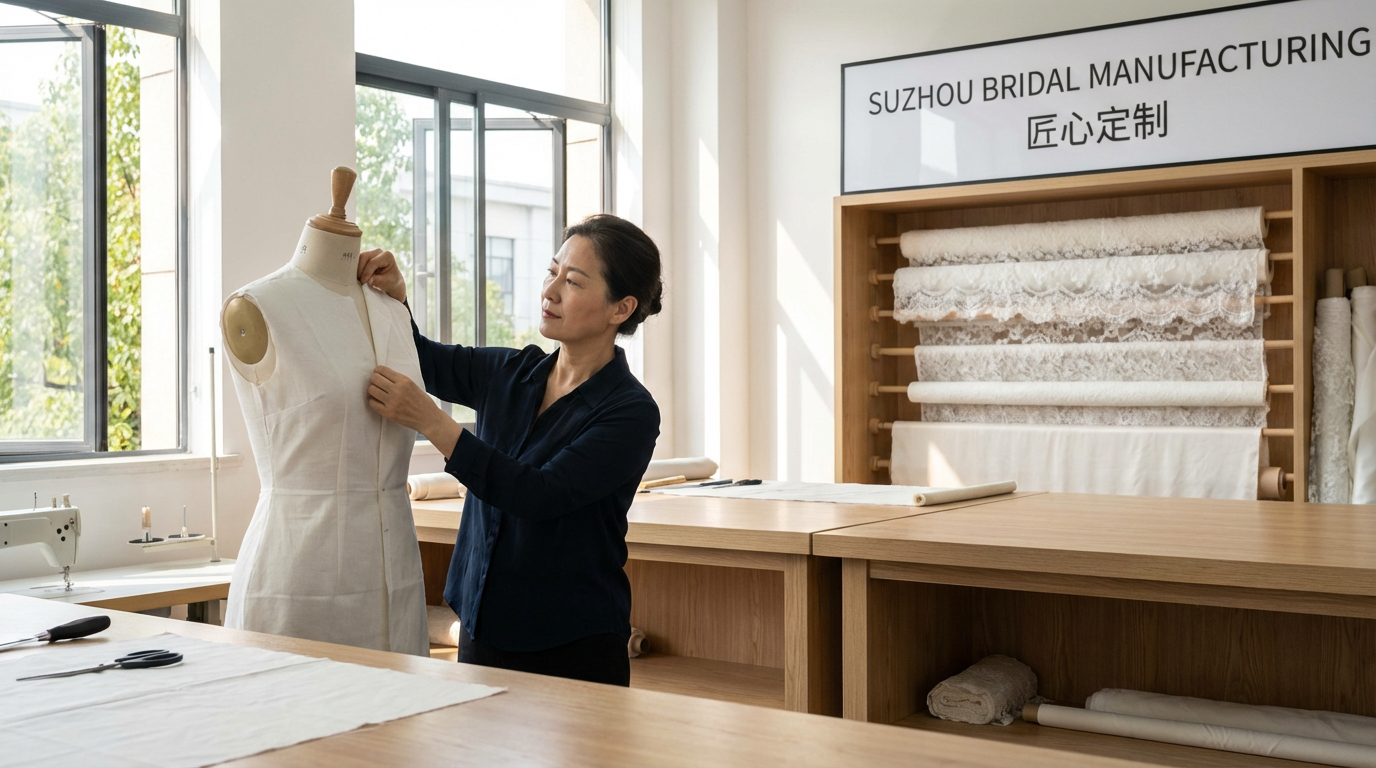
Before we touch the expensive French lace or the heavy silk crepe, we create a 'toile'—a mock-up made of calico or scrap muslin. This is where the magic (and the math) happens.
I always tell my pattern makers: 'The mannequin doesn't lie, but the bride needs to move.' We adjust the curve of the hip, the height of the boning, and the tension of the corset. If the toile isn't perfect, the final dress never will be. This phase is about 'fit consistency.' Whether your customer is a size 2 or a size 22, the engineering inside that dress must provide the same level of support and silhouette-shaping.
Fabric Intelligence: More Than Just 'Pretty'
Being in Suzhou gives us a massive advantage—we are at the heart of the world's best bridal supply chain. But having access to fabric is different from knowing how to use it.
'Sellability' often comes down to the drape. Does the chiffon flow like water, or does it stiffen up? We test every batch for colorfastness and seam slippage. If a designer wants a specific look but the chosen fabric won't hold the weight of the beadwork, we’re honest about it. We’ll suggest a reinforced tulle or a different lining that achieves the look without the structural failure. That’s what a strategic partner does—we protect your reputation.
Cost Engineering for Retail Success
Let’s talk business. A dress is only 'sellable' if you can make a profit on it. A factory that understands the US market knows how to 'cost-engineer' a gown.
Maybe that hand-beaded bodice is too expensive for your 'Silver' collection. We can suggest a high-quality lace appliqué with strategic hand-taped crystals that gives 90% of the sparkle at 60% of the labor cost. This isn't about cutting corners; it's about being smart with your budget so you can offer your brides incredible value while keeping your margins healthy.
Quality Control: From One to One Hundred
Making one beautiful sample is easy. Making 100 identical, perfect gowns for your wholesale orders is where most factories fail.
We use a rigorous AQL (Acceptable Quality Limit) system. Every gown goes through multiple checkpoints:
- The Cut: Ensuring the lace pattern is mirrored perfectly.
- The Construction: Checking that every bone is capped and every seam is finished.
- The Final Review: Measuring the finished gown against the original spec sheet.
If it’s off by even half an inch, it doesn't leave our floor. We know that in a bridal boutique, an inch of error is the difference between a happy bride and a returned dress.
Choosing Your Strategic Partner
Turning an idea into a sellable style requires more than just sewing machines. It requires a partner who understands your vision and has the 18 years of 'factory scars' to know what works and what doesn't.
At Huasha Bridal, we don't just want to be your supplier; we want to be your technical backbone. Whether you're a DTC brand or a traditional boutique owner, we’re here to make sure your designs don't just look good on paper—they look stunning on your brides and move quickly off your racks.
Ready to see how we can bring your next collection to life? Let’s jump on a WhatsApp video call. I’ll show you our current production line and our latest lace library. No pressure, just a transparent look at how we work.