Two-in-One Bridal Gowns: Why Convertible Wedding Dresses Appeal to Boutique Buyers
Two-in-One Bridal Gowns: Why Convertible Wedding Dresses Appeal to Boutique Buyers
I was chatting with a boutique owner from Chicago last month—let’s call her Sarah. She told me something that perfectly encapsulates the 2026 bridal market: "My brides aren't looking for 'The Dress' anymore. They're looking for 'The Moments.'"
What she meant is that the modern bride views her wedding as a cinematic sequence. There’s the grand entrance (the ceremony), the intimate dinner (the reception), and the high-energy party (the after-party). Traditionally, this meant selling two or even three separate dresses. But with rising costs and a desire for sustainable luxury, the Two-in-One Bridal Gown has become the ultimate strategic asset for retailers.
At Huasha Bridal, we’ve spent 18 years in the trenches of bridal manufacturing. We’ve seen trends come and go, but the shift toward modularity isn't just a fad—it’s an evolution in how we think about bridal construction.
The "Multi-Moment" Bride of 2026
Market data for 2026 is clear: 68% of brides are hunting for "transformable" styles on social media. They want the cathedral-length train for the aisle, but they want to be able to dance to 90s pop without tripping over five yards of silk tulle.
For you, the boutique owner, this is a massive opportunity. Instead of trying to convince a bride to blow her entire budget on two separate designer gowns—which often leads to "buyer's remorse" or a lost sale—you can offer a single, high-value convertible piece. It feels like a deal to her, but it carries a premium price point for you. It’s the definition of a win-win.
Why Your Rack Space Deserves a Double-Duty Gown
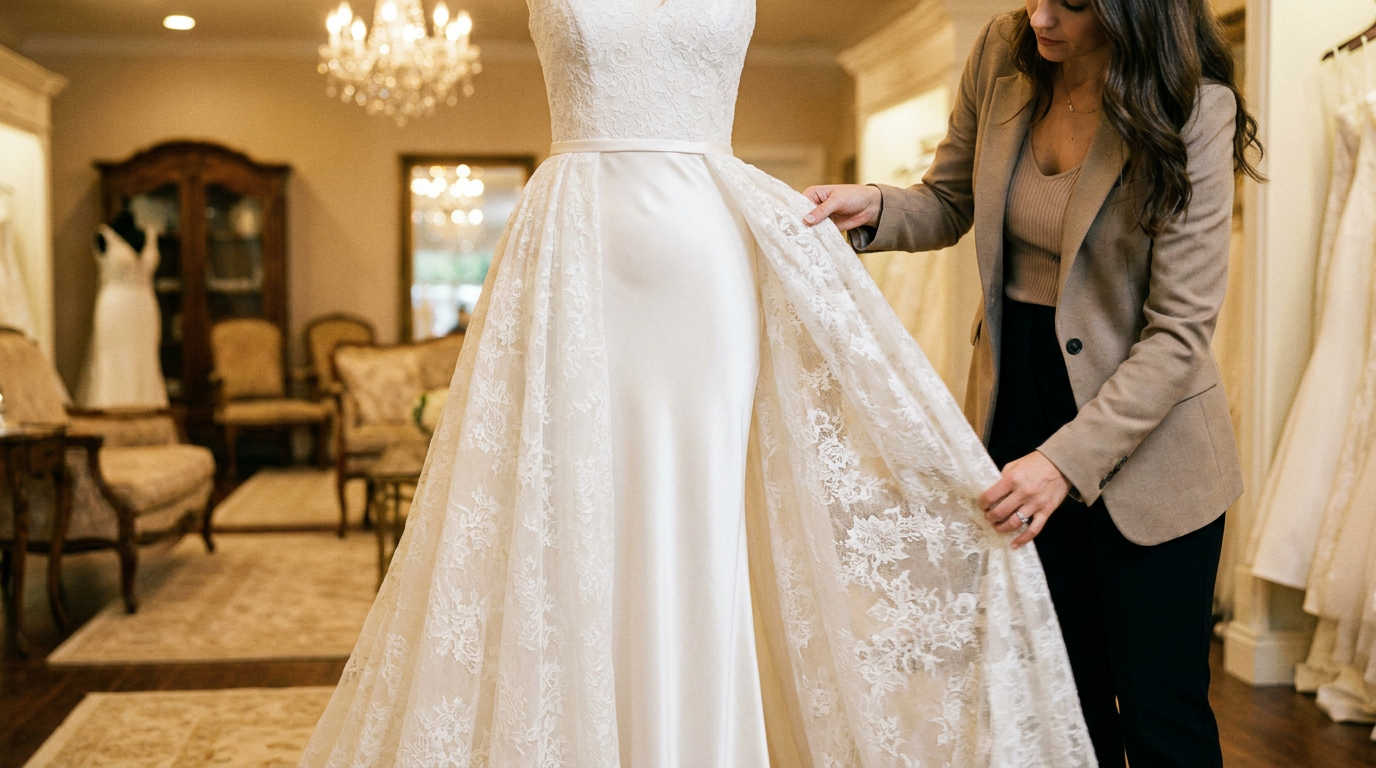
Inventory management is the silent killer of bridal boutiques. Every square foot of your shop is expensive. When you stock a convertible gown—say, a sleek crepe sheath with a detachable organza overskirt—you are essentially displaying two distinct looks while only occupying one hanger.
From a sales psychology perspective, the "reveal" of a transformation during a fitting is a powerful closing tool. I’ve seen it happen a thousand times: the bride is 90% sure about a dress, the stylist unclips the overskirt to reveal a party-ready mini, and the deal is sealed.
The Engineering Behind the Magic: It’s Not Just a Zipper
This is where my background as a factory manager kicks in. A convertible gown is only as good as its "connection points." If a bride is mid-reception and her detachable sleeve falls off, or if the hidden zipper on her overskirt jams, your boutique's reputation takes the hit.
At our Suzhou facility, we treat modularity as an engineering challenge. We don't just slap on some hooks. We use:
- Invisible Magnets: High-strength, lightweight magnets sewn into the lining for seamless sleeve attachments.
- Reinforced Waistbands: Because an overskirt can be heavy, we use internal grosgrain ribbons to distribute the weight so it doesn't sag or distort the base gown.
- Concealed Micro-Zips: We source Japanese-engineered YKK zippers that are thin enough to be invisible but strong enough to survive 50+ boutique try-ons.
Solving the "Color Match" Nightmare
One of the biggest risks when sourcing multi-look gowns from China is fabric variance. I’ve seen competitors ship a base gown in "Diamond White" and a detachable cape that is just a shade more yellow because they used different fabric dye lots.
Because Huasha Bridal operates with a fully integrated supply chain, we ensure that every component of a 2-in-1 gown is cut from the exact same roll of fabric. Whether it’s 300gsm heavy crepe or delicate 15D nylon tulle, the color consistency is absolute. This is the difference between a gown that looks expensive and one that looks like a DIY project.
The Quality Control Checklist for Modular Gowns
When you’re vetting a manufacturing partner for convertible styles, you need to ask about their AQL (Acceptable Quality Limit) for attachments. At Huasha, our QC team performs a "stress test" on every detachable element. We snap and unsnap every button ten times and check the seam slippage at the attachment points. We ensure the bone structure of the inner bodice can support the added weight of a 3-meter detachable train without losing its silhouette.
Partnering for the Future of Bridal
Transitioning your inventory to include more modular, white-label, or ODM convertible gowns doesn't have to be a gamble. It’s about finding a partner who understands the technical nuances as well as the aesthetic ones.
We’ve helped boutiques across the US build exclusive "convertible collections" that allow them to stand out from the big-box retailers. If you want to see how these mechanisms work in real-time, I’d love to show you. We can hop on a WhatsApp video call, and I’ll walk you through our showroom and show you the "invisible engineering" we’re so proud of.
Let’s turn those complex production needs into a clear, reliable solution for your shop. The 2026 bride is ready—are you?