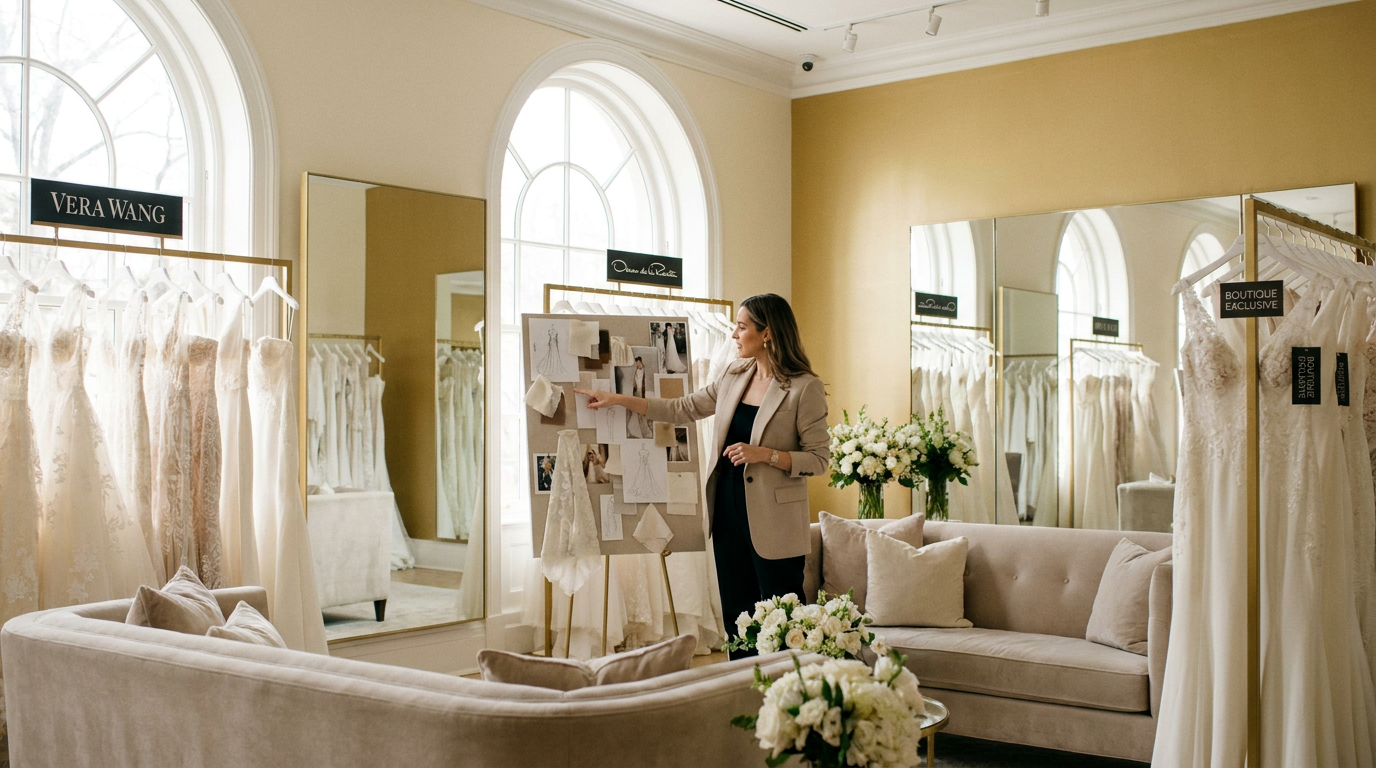
Vendor Strategy for Bridal: How to Reduce Risk While Expanding Differentiation
Let’s be real for a second: the bridal retail landscape in 2026 feels a bit like a high-stakes poker game. On one side, you have the massive global designer brands that bring in foot traffic but squeeze your margins with MAP (Minimum Advertised Price) restrictions and territory overlaps. On the other, you have the rising demand from Gen Z brides for something "exclusive" and "different."
I’ve spent 18 years on the manufacturing floor here at Huasha Bridal in Suzhou, and I’ve seen hundreds of boutique owners face the same dilemma. How do you stop being a showroom for brands that brides eventually find cheaper elsewhere? The answer isn't to ditch big brands entirely—it’s to master a hybrid vendor strategy that balances "Anchor Brands" with high-margin "In-House" collections.
The 2026 Bridal Retail Paradox
We are seeing a shift toward what I call "Intentional Inventory." The days of ordering 50 gowns from a single designer and hoping for the best are over. Today’s most successful US retailers are keeping about 30% of their floor space for those big-name anchors and dedicating 70% to exclusive white-label or ODM (Original Design Manufacturing) pieces.
Why? Because that 70% is where your profit lives. When you work directly with a partner like us, you aren't just buying a dress; you're capturing that 20-30% middleman margin that usually goes to the brand's marketing and corporate overhead.
Identifying the 'Invisible Risks' in Your Current Strategy
Most shop owners worry about shipping delays, but the real "invisible risks" are deeper:
- Inventory Bloat: Traditional designer cycles take 9-12 months. If a trend shifts (like the current craze for Basque waists or 3D floral textures), you’re stuck with outdated stock.
- Lack of Differentiation: If the shop three blocks away carries the same three designers, you’re competing on price, not personality.
- Quality Inconsistency: Many big brands outsource to multiple factories, leading to fit issues between different seasons.
At Huasha, we solve this by acting as your strategic manufacturing partner. We focus on sourcing agility, offering 4-6 month lead times so you can respond to what your brides are actually asking for right now.
Differentiation as a Defense: Why White-Label and ODM are Essential
I always tell my partners: "Your brand is your strongest asset." By creating a private label collection, you control the narrative.
If a bride falls in love with a modular design—perhaps a sleek crepe gown with detachable 3D lace sleeves—and that gown is exclusive to your shop, the price comparison game ends. You are no longer selling a product; you are selling an experience and a vision.
Our ODM services allow you to send us a sketch or even a mood board. My design team in Suzhou then translates that into a production-ready reality, ensuring the internal structure—the boning, the cups, the hidden corsetry—is up to the rigorous standards of a luxury US boutique.
Risk Mitigation Checklist: From Suzhou to Your Showroom
Sourcing from China shouldn't feel like a gamble. When I manage production at our factory, we use a strict AQL (Acceptable Quality Limit) system. Here is what you should demand from any manufacturing partner:
- Fabric Integrity: We test for seam slippage and colorfastness. If that ivory satin has a hint of blue under showroom lights, it doesn't leave our floor.
- Fit Consistency: US sizing (0-28) requires specific block patterns. We’ve refined ours over 18 years to ensure that a size 12 fits like a size 12 every single time.
- Structured Packaging: There is nothing worse than spending three hours steaming a gown because it was crammed into a small box. We prioritize packaging that maintains the gown’s shape during transit.
Operational Excellence: Managing Landed Costs
To truly reduce risk, you need to understand your Landed Cost. This isn't just the price of the dress. It’s the dress + HTS duties + shipping + local prep labor.
By working with a low-MOQ (Minimum Order Quantity) factory, you can test "micro-drops" of 3-5 gowns. This allows you to see what resonates with your local market before committing to a larger run. It’s the smartest way to keep your cash flow healthy while expanding your reach.
Let’s Build Your Exclusive Collection
Building a private label isn't just about labels; it’s about taking control of your business's future. At Huasha Bridal, we don't want to be just another name on your vendor list. We want to be the engine behind your brand’s growth.
I invite you to hop on a WhatsApp video call with me. I’ll walk you through our Suzhou showroom, show you the drape of our latest silks, and introduce you to the artisans who could be making your next best-seller. Let’s turn your design vision into a reliable, profitable reality.
Ready to differentiate? Let's talk.