What Online Bridal Retailers Should Look for in a White Label Wedding Dress Partner
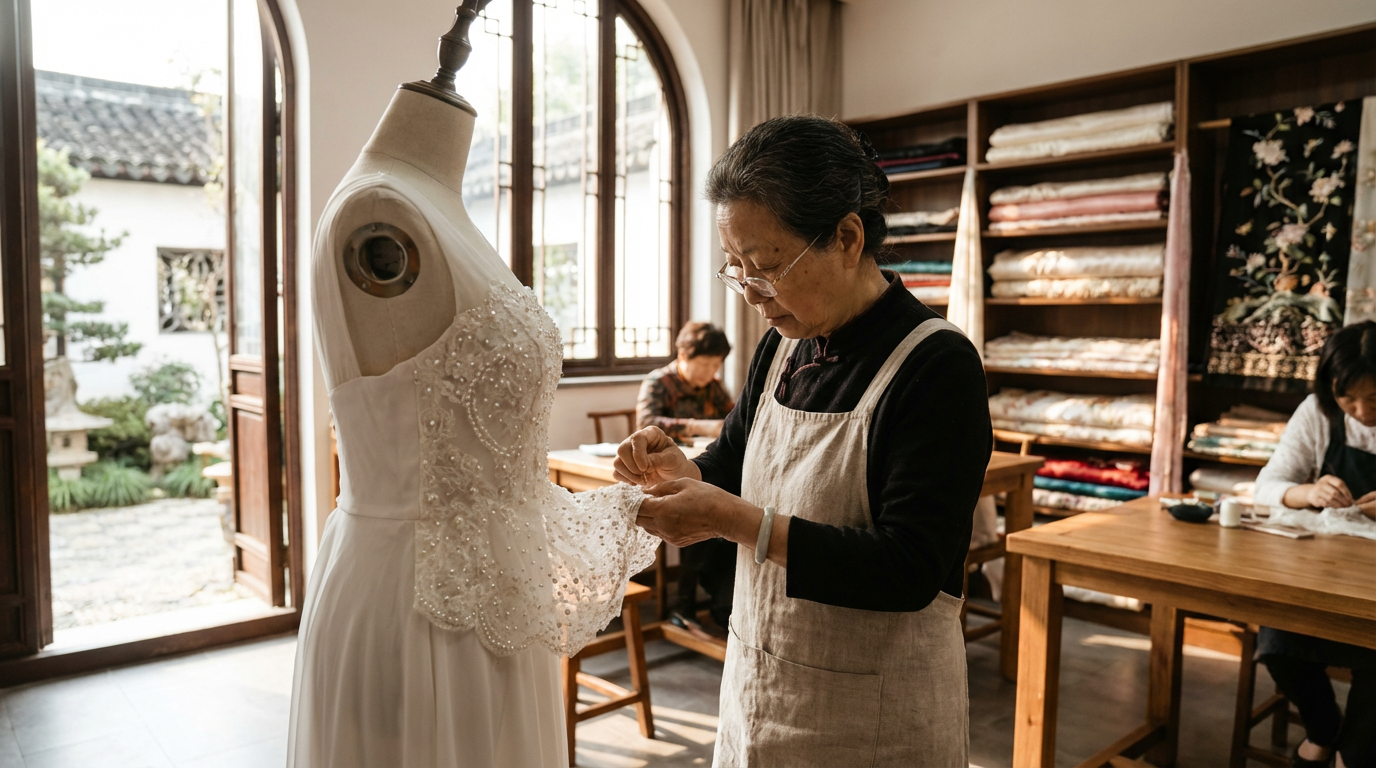
I’ve spent the last 18 years in the heart of Suzhou’s bridal district, and if there is one thing I’ve learned, it’s that a beautiful photo is the easiest thing to produce. The hardest thing? A dress that actually looks, feels, and fits like that photo when it arrives at your customer's doorstep in New York or Los Angeles.
For online bridal retailers and DTC (Direct-to-Consumer) brand owners, your manufacturer isn't just a vendor; they are the backbone of your reputation. When a bride opens that box, she isn't thinking about a factory in China. She’s thinking about your brand. If the lace is scratchy or the boning is flimsy, that’s on you.
So, how do you find a white label partner that actually makes you look good? Let’s dive into the pillars of a successful partnership.
Pillar 1: Structural Integrity—Beyond the Pinterest-Perfect Photo
We’ve all seen the horror stories: a bride orders a gown online and receives something that looks like a high school craft project. As a designer and factory manager, I can tell you exactly why that happens. Most low-cost factories skip the internal architecture.
A high-quality wedding dress is a piece of engineering. When you are vetting a white label partner, ask them about their bodice construction. At Huasha Bridal, we use a minimum of 12 to 15 pieces of high-quality boning in our structured bodices. We use multi-layer interfacing to ensure the shape holds, even for plus-size brides.
What to look for:
- Boning quality: Is it plastic or high-density resin? Does it poke through the fabric?
- Built-in cups: Are they cheap foam or molded, supportive cups?
- Lining: Is it a breathable, high-GSM (grams per square meter) satin, or a thin, static-heavy polyester?
Pillar 2: Customization and Private Label Capabilities
If you are building a brand, you need more than just a dress; you need a cohesive brand experience. A true white label partner should offer seamless private labeling.
I always tell our partners: "Your logo should be the first thing the bride sees." This means the factory should be able to handle custom woven labels, hangtags, and even branded garment bags. But it goes deeper than just tags. Can the factory modify a neckline? Can they swap a zipper for a corset back?
In the online world, "Bespoke Efficiency" is the new gold standard. You want a partner who can take an existing design from their catalog and tweak it to fit your brand’s specific aesthetic. This allows you to offer 'exclusive' designs without the massive overhead of a full custom collection.
Pillar 3: The 'Suzhou Advantage' in Fabric Sourcing
Being based in Suzhou isn't just about location; it’s about access. This city is the global epicenter of bridal silk and lace. When you work with a partner like Huasha, you are tapping into a massive, sophisticated supply chain.
I’ve seen retailers struggle because their supplier couldn't find the same lace for a re-order. That’s a nightmare for an online store. You need a partner who has long-standing relationships with lace mills. We maintain a library of thousands of lace patterns and fabrics, ensuring that when your best-seller goes viral on TikTok, we can actually get the materials to fulfill the orders.
Expert Tip: Ask your potential partner for a fabric specification sheet. If they can't tell you the fiber content or the weight of the crepe they are using, they probably don't have control over their supply chain.
Pillar 4: Transparency and the 'Fear of China Sourcing'
I get it. Sourcing from China can feel like a gamble. The distance, the language barrier, and the fear of 'quality fade' are real concerns.
The best way to bridge this gap is through radical transparency. I personally love doing WhatsApp video calls with our clients. I’ll walk them through the cutting floor, show them the hand-beading station, and let them see the QC (Quality Control) process in real-time.
If a manufacturer is hesitant to show you their facility or their process, that’s a red flag. Look for a partner who uses a structured QC system (like AQL standards) and provides photo or video proof of your specific orders before they ship.
Pillar 5: Scalability and Fair MOQs
Online startups often face a dilemma: they can't commit to 500 dresses, but they need wholesale pricing to survive.
A good white label partner understands the growth curve. We often work with DTC brands on a tiered MOQ (Minimum Order Quantity) basis. Maybe you start with a small sample run to test the market, and as your data shows what’s selling, we scale up production. This agility is what separates a 'factory' from a 'strategic manufacturing partner.'
10 Questions to Ask Your Potential Partner
- Can I see photos of the inside of a finished gown?
- What is your standard lead time for a 10-dress order vs. a 100-dress order?
- Do you offer unbranded, high-resolution photography for my website?
- What is your process for handling a defect if one slips through?
- Can you provide a tech pack for the designs I’m interested in?
- How do you ensure sizing consistency across different fabric types (e.g., stretch crepe vs. stiff mikado)?
- Are you able to source eco-friendly or recycled lace?
- What are your shipping insurance policies for US-bound freight?
- Can we do a live video tour of your production line?
- Do you have experience working with US-based sizing standards (which differ significantly from Asian or European sizing)?
The Bottom Line
Building an online bridal empire is hard work, but it’s a lot easier when you aren't fighting your factory every step of the way. You need a partner who values your brand as much as you do.
At Huasha Bridal, we don't just sew dresses; we build the foundations for your business success. If you're tired of the 'sourcing lottery' and want to see what 18 years of expertise looks like, let’s talk. I’d love to show you around our Suzhou facility—virtually or in person.
Ready to scale your bridal brand? Contact us today for a consultation and let’s turn your vision into a reality.