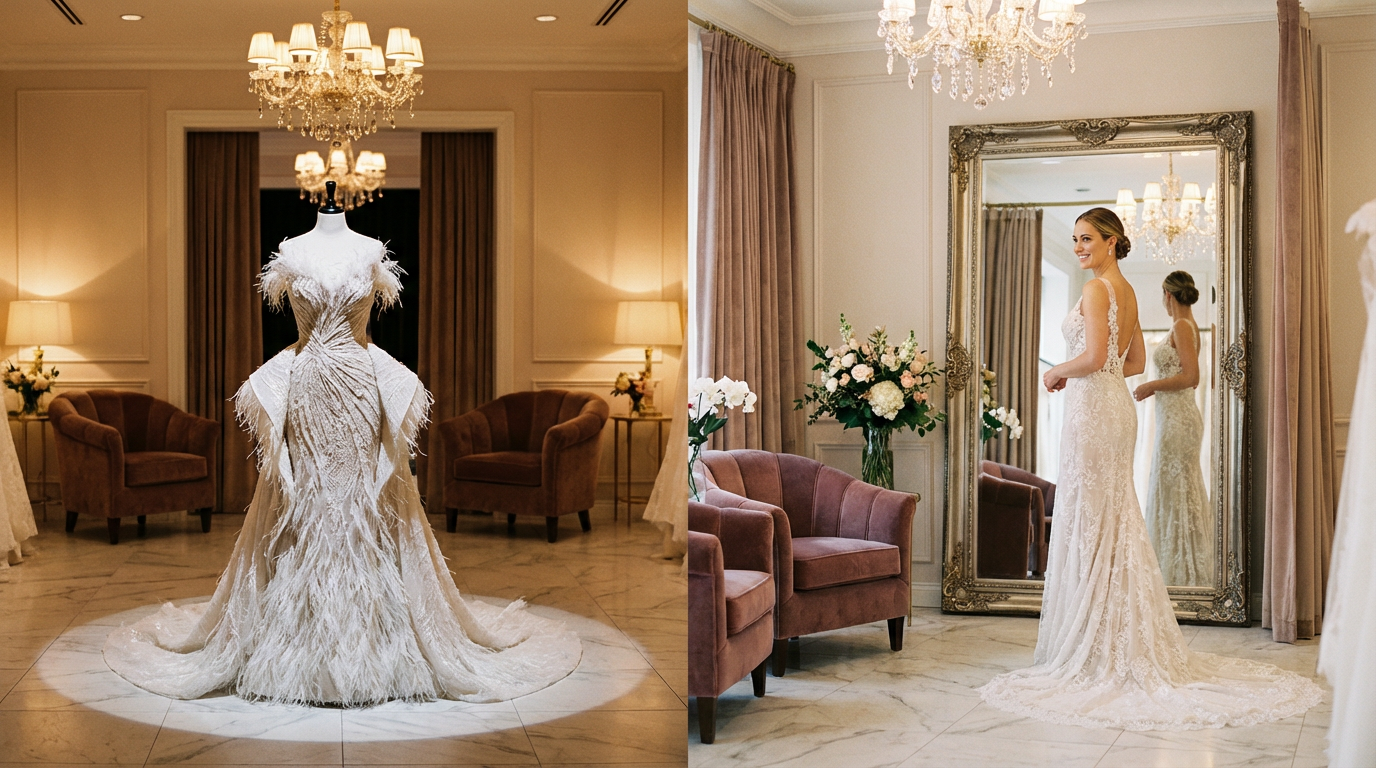
Why Some Runway Bridal Trends Create Buzz but Fail in Real Appointments
I remember standing in the front row of a major bridal fashion week in New York a few years back. The lights were blinding, the music was pulsing, and this incredible gown floated down the runway—it had these massive, architectural puff sleeves and a sheer bodice that looked like it was spun from moonlight. Every editor in the room was snapping photos. I thought, "This is it. This is the future."
Fast forward six months. I was visiting one of our partner boutiques in the Midwest. That same dress—or a very close version of it—was hanging on the 'Sale' rack, untouched. The owner looked at me and sighed. "It looks amazing on Instagram," she said, "but as soon as a real bride puts it on, she can’t move her arms, and her mother-in-law has a heart attack over the sheer lace."
That’s the Commercial-Couture Gap. As someone who has spent 18 years at Huasha Bridal bridging the gap between high-fashion sketches and factory floor execution, I’ve seen this story play out a thousand times. Today, I want to pull back the curtain on why "viral" doesn't always mean "sold."
The Psychology of the 'Runway High'
Runway shows are designed to create an emotional peak. They are theater. Designers use extreme silhouettes and avant-garde fabrics to grab headlines and define a brand’s "DNA." But here’s the reality: runway models are often a size 0-2 and 5'11".
When that same trend hits your boutique floor, it meets the "Real Appointment Reality." The average American bride isn't a runway model. She wants to feel beautiful, yes, but she also wants to be able to hug her grandmother, eat a piece of cake, and dance to 'September' without a wardrobe malfunction.
The Three Pillars of Retail Failure
Through my years managing production at our Suzhou factory, I’ve identified three main reasons why a trend fails when it moves from the catwalk to the fitting room.
1. The Fit vs. Fashion Conflict
High-fashion often ignores the internal structure for the sake of an external silhouette. Those plunging necklines look great on a mannequin, but without the right internal corsetry—something we obsess over at Huasha—they offer zero support for a bride with a real bust. If a dress requires a bride to hold her breath for four hours, she isn't buying it.
2. The Fabric Trap
I’ve seen designers use stiff, heavy brocades that look like a million bucks on a 30-second runway walk. But in a real wedding in July? That bride is going to overheat. Or take the ultra-delicate "illusion" tulles that are so fine they tear if a bridesmaid even looks at them funny. At Huasha, we test every fabric for "wearability." If a fabric doesn't have the right GSM (grams per square meter) or hand-feel, it’s a liability for your boutique.
3. The Alteration Nightmare
This is the silent killer of boutique profits. A dress might look stunning, but if it’s covered in 3D florals that cross every major seam line, your seamstress is going to charge the bride a fortune to take it in. When a bride hears that alterations will cost 50% of the dress price, she walks away.
Strategic Buying: The 80/20 Rule
So, how do you keep your shop looking modern without filling your racks with "dead stock"? I always tell my partners to follow the 80/20 rule.
- 80% Bread and Butter: These are your "Wearable Opulence" pieces. Think clean lines, high-quality crepes, and classic A-lines with a modern twist. These are the dresses that pay the rent.
- 20% The "Wow" Factor: These are your runway-inspired pieces. They bring brides into the shop. They look great in your window display. Even if they don't sell every week, they build your brand's fashion authority.
How Huasha Bridal Bridges the Gap
When we work on White Label or ODM projects for our US clients, our job is to "commercialize" the trend. We take that high-fashion inspiration and ask the tough questions:
- Can we add a detachable lining to this sheer bodice for more conservative markets?
- Can we make these oversized sleeves removable so the bride can dance?
- Is the seam allowance generous enough for easy US alterations?
We don't just manufacture dresses; we manufacture solutions. We take the "buzz" and turn it into a "buy."
Conclusion: Your Partner in Production
Choosing inventory is a gamble, but it doesn't have to be a blind one. You need a manufacturing partner who understands that a dress isn't finished when it leaves the sewing machine—it’s finished when a bride says "Yes" in your shop.
If you’re tired of trends that don't translate to sales, let’s talk. I’d love to show you our latest collection via a WhatsApp video tour of our Suzhou showroom. We’ve spent 18 years perfecting the balance between "Runway Chic" and "Retail Ready."
Ready to curate a collection that actually moves? Contact us today at Huasha Bridal.